
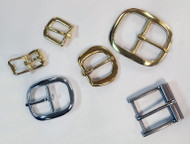
Types of Belt Buckles and Strap Buckles
As a leather shop, we deal with many types of belt and strap buckles, seeing and using them for many different applications. From belts, to purses, and dog collars, they can be found on just about any strap that allows for adjustment.
Not all buckles are the same. The buckle you want to adjust your camera strap, and the one you may want on your belt could be vastly different in size, shape, metal, and style. The one on your camera’s neck strap might be purely functional, while the other that sits at your waist may be entirely decorative, despite its functionality.
Regardless of whether you are looking for that buckle to make or break an outfit, or the one that will bring you the most comfort in your day to day, this blog post will take you through everything you need to know about the buckles you may encounter at Leathersmith Designs. We will also cover the methods of buckle attachment, as well as how to make a leather keeper.
Buckle Measurements
Before getting into the different styles and buckle types, it is important to know how buckles are measured. The measurement you will see is of the inside width of the buckle, or the length of the buckle bar inside the frame. This measurement indicates the space available for a strap width. Note that the width of the strap may have to be slightly smaller to fit the buckle properly so it won't be too tight.
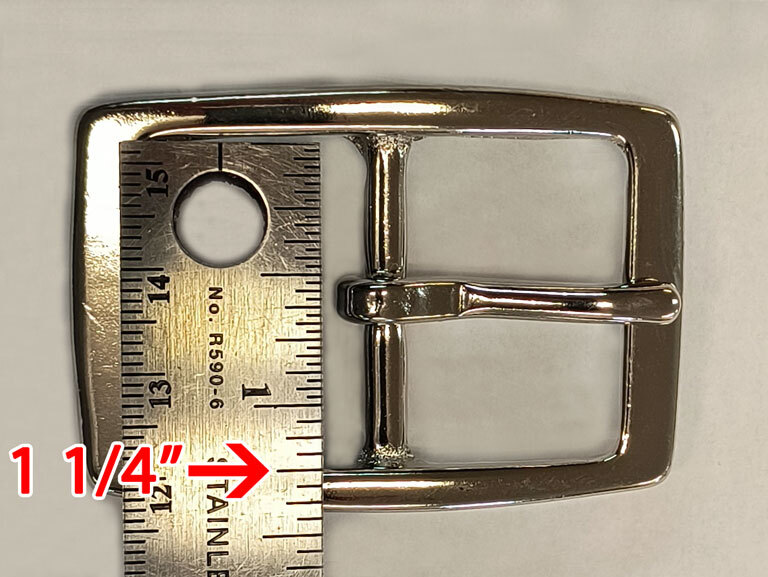
Belt buckle size is measured on the inside of frame, so you know how space there is for your leather strap.
Metals and Finishes
Gold or silver? Or maybe something else? Most of the buckles you will come across are very rarely made of either gold or silver. Instead, they are composed of or are plated with a metal or alloy that looks like one of the two. For example, pictured above is a nickel silver belt buckle, which is a solid brass with a nickel plating.
When it comes to the gold color, you’ll likely find solid brass, gilt plated, and brass plated. Whereas the silver options are likely to be zinc alloys, aluminum, steel, stainless steel, and nickel, or chrome plated. A buckle that is plated in a metal has a thin layer of that specified metal as its outer layer. The inner core could be anything, although most commonly steel, zinc alloy, or brass.
If the metal of a buckle is already the desired color, then it is not plated. An example of this would be solid brass, as it is naturally a fine gold color, or stainless steel, which is a nice silver color. As such, it is not necessary to plate these metals. That said, If the manufacturer is already producing a buckle but wants to offer it in a variety of finishes, or if there is a preference for the specific properties of a metal, it may be plated to meet those aesthetic requirements. This is why you will commonly come across solid brass buckles plated in chrome or nickel.
If you happen to have a nickel allergy or sensitivity, then making the metal composition your biggest priority would be ideal. The severity of your allergy will be the main factor in both limiting and determining the buckles you may be able to use. Due to the range in severity and sensitivity this allergy incurs, we encourage you to use your own knowledge and experience in determining what metals are safe for you.
Nickel is very durable, plentiful, cheap, and has anti-corrosive properties, and so it is very common to see in alloys. For this reason, if you have a severe or very sensitive nickel allergy, seeking out the specification “nickel free” or “0% nickel” will be in your benefit. Unless specified, it is likely that there will be, at the very least, trace amounts of nickel in any metal buckle.
That said, those with less severe nickel allergies have found success opting for non-plated solid brass belt buckles. These buckles are gold in color and are an alloy of copper and zinc. Tin, aluminum, or manganese may also be added to enhance specific properties such as strength, ductility, corrosion resistance, and color variance. If solid brass works for you, then you will want to assure that your fastening hardware (the snaps or rivets) are also made of solid brass.
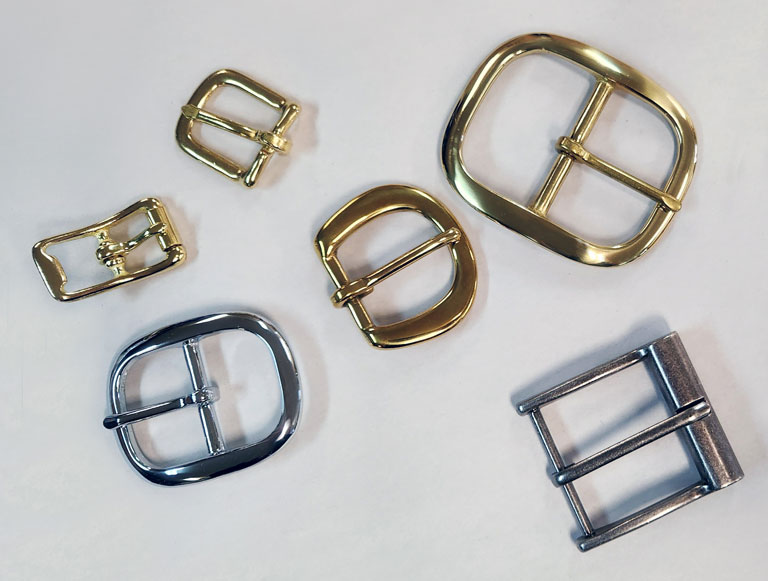
Strap buckles come in a variety of finishes and metals such as chrome, antique, solid brass, stainless steel, and zinc.
Frame Style Buckles
A frame style buckle is probably what you think of when you imagine a belt buckle. It is a metal frame that utilizes a tongue or prong to lock into a straps hole. This tongue is attached to the bar of the buckle, which is the area of the buckle that will be attached to the strap. This style of buckle requires an accommodating oblong hole to allow for easy use and movement of the buckles tongue.
Frame buckles come in a range of shapes, sizes, and styles. Due to the simplicity of the frame buckle, they are mostly found in square, rectangular, circular, and semi-circular varieties. Some of these buckles may fall somewhere in between these different shapes or may be entirely unique. Despite how relatively minimalistic they may be, this does allow for variety. You can check out some of this variety in our online buckle store, located under "Belt Buckles and Strap Buckles" in the leathercraft supplies section on our website.
Half Buckles / Heel Bar Buckles
Heel bar buckles have their bar and tongue on the end of the buckle. If you happen to go belt shopping, you’ll notice that these, in their single prong format, are the most commonly used style of belt buckle. It is customary for heel bar buckle to have a leather keeper to assure the belt’s pointed end is kept snug. Within this style of buckle, you will find that the range in shape is relatively large as far as frame buckles go. Finding square and rectangular buckles, as well as semi-circular and even ones that fall somewhere in between. By shape they are really only limited by the straight bar at its heel.
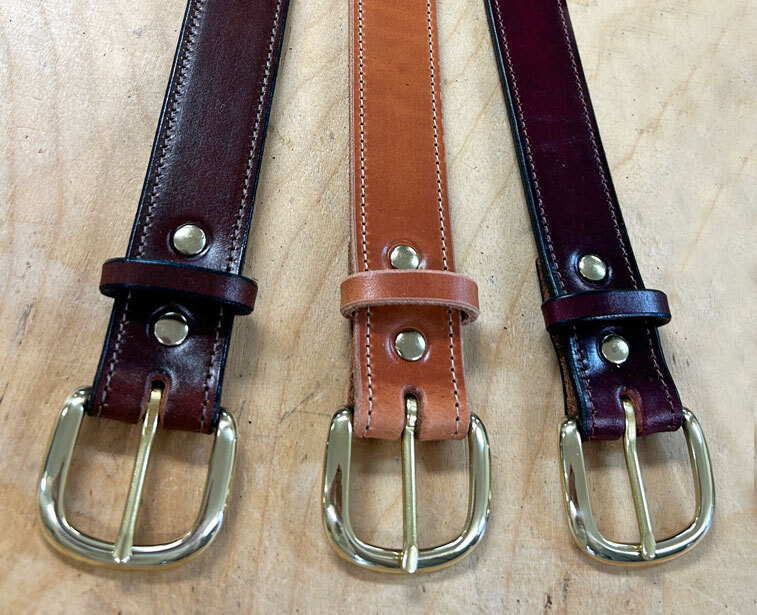
Solid brass heel bar buckles on full grain leather belts.
Full Buckles / Center Bar Buckles
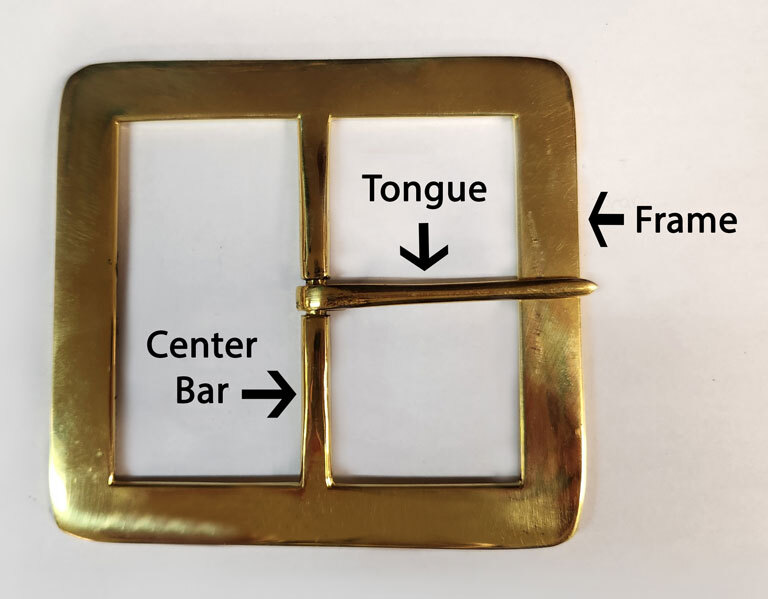
Center bar buckles, just like the name suggests, have their bar and tongue in the center of the buckle. The strap is attached to this buckle via its center bar, as opposed to the buckles end like the heel bar buckle.
When you pull the straps pointed end up through the far end of the buckles frame, setting the tongue in your preferred hole, you then push it down through the opposite end of the frame. The center bar acts as a mediator, creating these definitive sides while aiding in keeping the belt’s end snug. This differs from the heel bar buckle which requires a leather keeper to fulfill this exact purpose. The fact that the buckle itself takes care of the straps end might be why the center bar buckle is often chosen to be used on adjustment straps as opposed to the heel bar variety, which is more common on belts.
Similar to the heel bar buckle there is a lot of variety in regard to shape. Most of these buckles do stick to the forementioned shapes of rectangular, square, and circular, however many do end up falling somewhere in between.
On the full buckle (center bar buckle) below, you can see the pointed leather belt end is held under the frame on the right of the buckle where the red arrow is pointing.
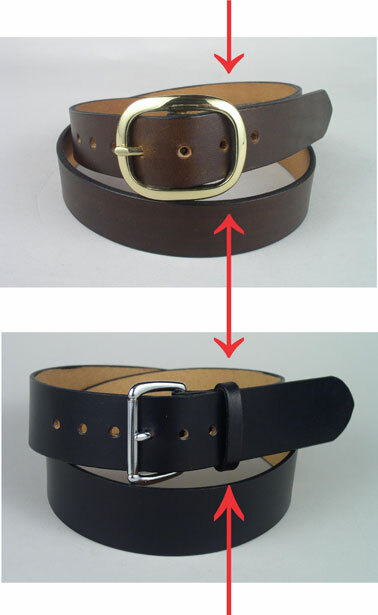
On the half buckle (heel bar buckle) above, there isn't any frame on the right where the red arrow is pointing to hold down the pointed leather belt end, so a leather loop (keeper) must be made to serve that function.
Double Tongue / Two Prong Buckles
These buckles have two prongs rather than one, and are seen in both half and full buckles, but are more commonly heel bar buckles. The belts and straps that sport this type of buckle will have two parallel rows of adjustment holes. While more of an aesthetic choice, these buckles are on the more rectangular / square side of things and have a punkier, more industrial look.
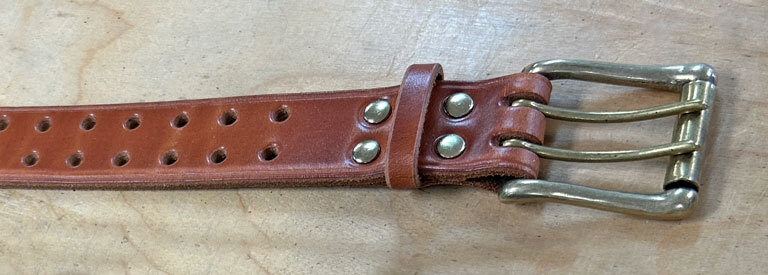
Double prong buckle on leather belt with a series of adjustment holes for function and style.
Roller Buckles
A roller buckle is any frame buckle that has a free moving cylindrical addition wrapped around the end of the buckle. This metal piece moves along with the leather as you maneuver it, which decreases the amount of friction received on the straps end. This can aid in reducing wear on the leather surface. That said, the prongs on any frame buckle, with regular adjustment can wear and can stretch the holes overtime. This hole fatigue wear is noticed mostly in mass produced belts that are not 100% real leather as opposed to solid full grain leather belts. For more information on this topic, check out our article "Leather Belts Made From Which Types of Leather?".
These buckles are usually a little more chunky or bulky, due to the roller adding to the buckles overall thickness. Like the two-prong buckle, roller buckles are usually more on the rectangular / square side of things. They are commonly found on harnesses, dog collars, weightlifting belts, and industrial belts. You can see heel bar roller buckle styles as well as center bar roller buckles used in these applications.
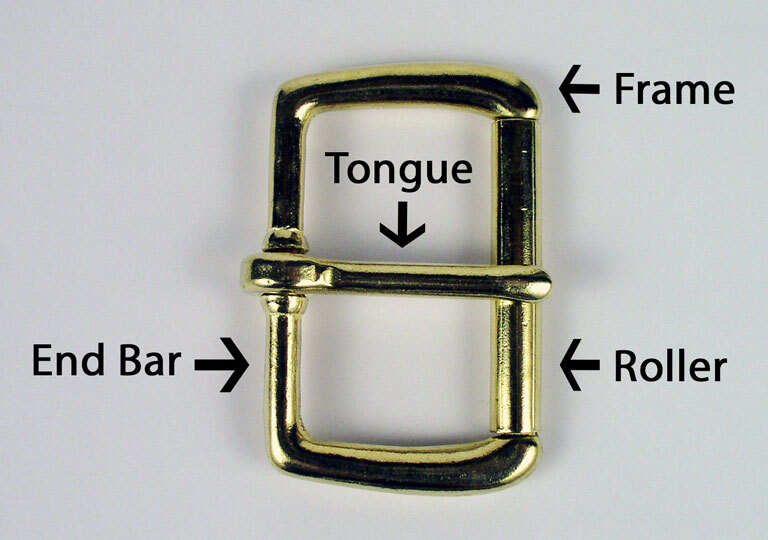
Roller buckles have a round rotating cylinder (roller) which reduces wear on the leather.
Novelty and Plate Style Buckles
Novelty and plate style buckles are more commonly used as belt buckles than anything else. These buckles are made to be expressive. They can showcase a wide variety of designs, interests, aesthetics, styles, and even ideas, making them akin to the graphic tee-shirt of belt buckles. For example, western belt buckles may have themes of horses, floral designs, rodeo, roping, steers, and ranger crests.
A plate style buckle is a buckle whose main feature is a (typically) decorative plate. There is much variance in plate shape, however most will be oval, rectangular, or something in-between. That said, they are not limited to those options and can come in totally different and unique shapes.
Not every novelty buckle is a plate style buckle. This is more obvious when you compare something like our Imperial Dragon Novelty Buckle and the Coyote Trophy Buckle. The Coyote buckle is a plate style buckle, whereas the Dragon buckle does not have its intricacies on a metal plate, but rather in the form of the buckle itself.
The commonality with these ornate belt buckles is their aptitude for expression as well as the utilization of either a pin or a hook style hole lock rather than a prong or tongue. As they lack a tongue, they do not need an oblong hole punched in the strap when attaching it to the bar of these buckles.
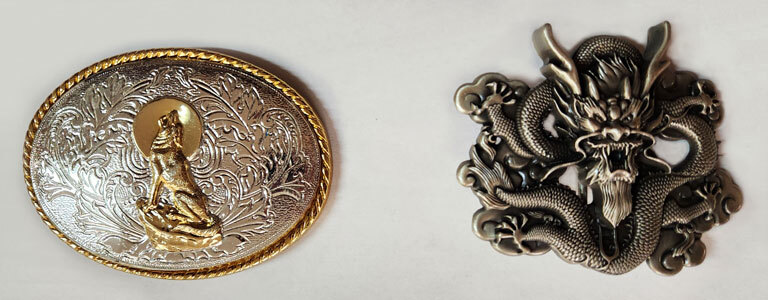
Wildlife Novelty Belt Buckles - Left buckle is a metal plate style whereas the right buckle is not.
Attaching Buckles
There are several ways to attach a buckle to a strap. The steps you take and method you choose will depend on the type of buckle you have chosen, as well as if that buckle is to be a permanent fixture on the strap. As mentioned above, frame buckles have tongues and those tongues need an oblong hole sized to that tongue, allowing it to move without strain, whereas a novelty buckle will not.
You will need to mark where the oblong hole will need to be punched, if there is one, as well as be mindful of how much leather you will need to properly attach the buckle to the strap.
The most common methods of permanent attachment are riveting and sewing the buckle to the strap, while non-permanent attachment methods use snaps or Chicago screws (Screw Posts). You can find our blog posts on "How To Rivet Leather", and "Setting Snaps In Leather". We also have a video on "Using Screw Posts In Leather". Below we will describe sewing as an attachment method. You can find more information in the Sewing Leather section of our "Leatherworking Tools Intro" blog post.
Many of the belts you will find in stores have their buckles sewn onto their straps. This is a common attachment method on all types of adjustment straps. You can either machine or hand sew the buckle to the strap, both of which will differ in time spent and in method.
You will first want to thin the leather thickness of the strap’s end if needed to create a pliable, snug fit and then place your buckle on the strap. You will mark where you want your row of stitching to be. If you are hand sewing, we suggest using an Overstitcher tool to mark your stitch spacing. If you are using a sewing machine rated for leather, then in placing the foot down, you will want to keep the buckle snug. You will create a straight stitch, locking the stitch in by backtracking at both the beginning and ends of this stitch.
For hand sewing, using the outline you created, you will then use a Leather sewing awl to make the holes that will allow your needle and thread through the leather. If you are using a lockstitch sewing awl tool however, the awl, the needle and the thread are all in one, saving some of the steps. You will want to use a method similar to that on a sewing machine to assure a snug and secure stitch is created by backtracking your stitches.
Leather Keepers
If the buckle you are attaching is a half buckle or novelty buckle, you will want to include a leather keeper. This leather keeper will need to be flexible and pliable, so you may want to use thinner leather for this loop than the leather you may be using for your strap. You can, however, use scrap leather from your project and thin out the keeper if you have a way to do so.
To make a leather keeper, you will take this piece of leather and cut it to your desired width of keeper. You can then bevel and dye the edges of the keeper (optional). If you are thinning out this piece of leather, this is the best time to do that, making sure to cut any frays on the edges that may appear from this process.
You will now use your strap to take a measurement for the keeper. Folding the strap on itself so that it is doubled up, you will take the keeper and wrap it around the double thick strap, making a mark on the keeper where it meets itself. From here you will cut off the excess leather from your keeper and then staple (or sew) the ends of the leather together so that it creates a loop. This is your keeper.
You have the option to either secure this keeper to the strap, or to leave it freestanding so that it is able to move along the strap freely. If you are leaving it freestanding, putting it on the belt after you attach the buckle will require no extra steps. Below we will discuss how to securely attach this keeper to your strap.
To secure the leather keeper to the strap, we will be placing it in between two rivets, snaps, Chicago screws, or parallel lines of stitching. The keeper will come after the buckle has been placed and secured by the first snap, rivet, screw, or seam. Placing the keeper after this, between the fold in the leather, you will then be adding the second rivet, snap, screw post, or line of stitching on the keepers opposite side. Be sure to place the keeper so that the staple side is tucked between the leather, keeping it hidden.


